What Are the Best Homeopathic Remedies for Hot Flashes?
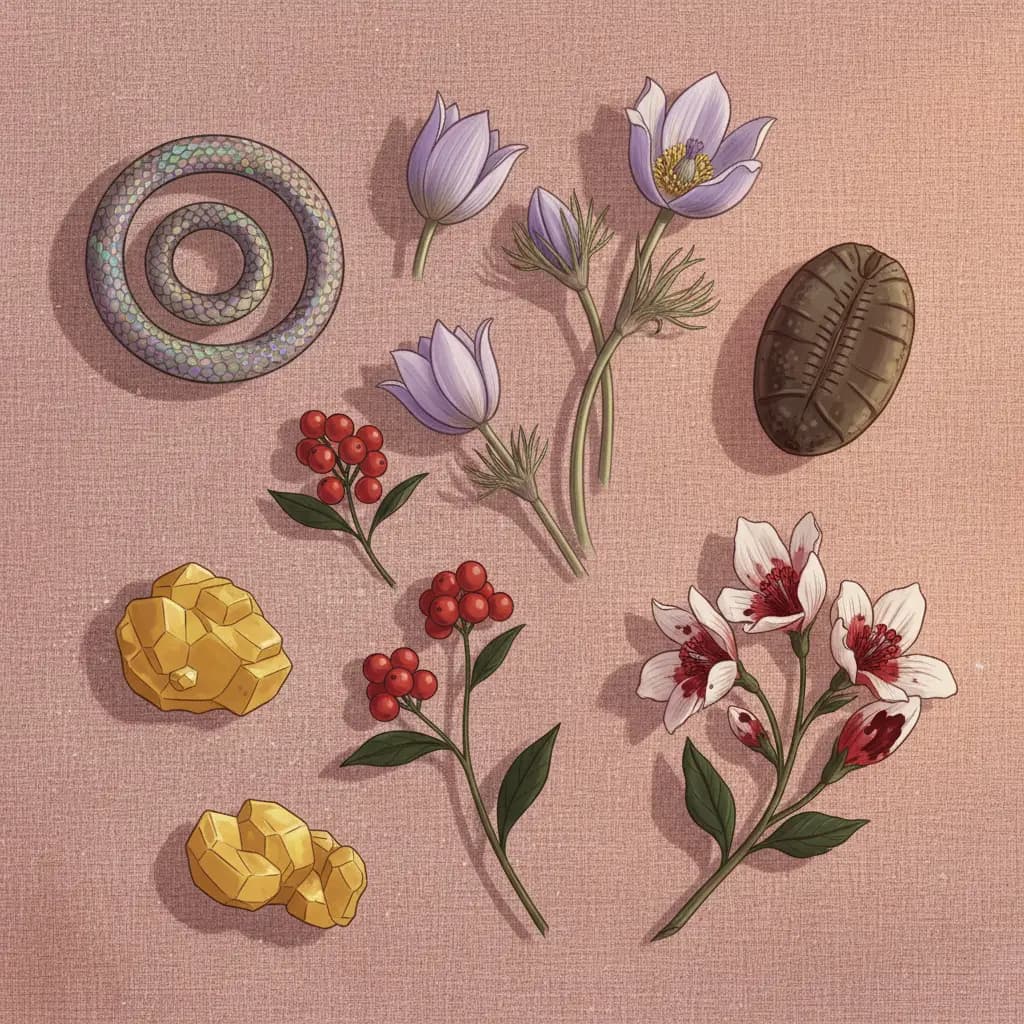
The best homeopathic remedies for hot flashes include Lachesis (flushes on waking, left-sided, cannot bear anything tight at neck or waist), Sepia (sudden flush with sweat then chill, dragging-down weakness, indifference to family), Pulsatilla (changeable, weepy, worse in a warm room, craving open air), Glonoinum (a rush of blood to the head with throbbing and a pounding pulse), Sulphur (burning heat, especially of the feet, kicking the covers off), Belladonna (sudden red throbbing flush with a hot dry face), and Sanguinaria (flushes rising into the face with red burning cheeks, right-sided). Each is chosen by the quality of the flush and what travels with it, not by the word "menopause" alone. This guide covers how to read the flush, how to tell these remedies apart, and when a practitioner's prescription adds the most.
Quick Answer
| Remedy | Best when… |
|---|---|
| Lachesis | Flush rises on waking, worse left side, cannot bear a collar or waistband, talkative, relieved when the flow starts |
| Sepia | Flush sweeps upward, ends in sweat then chill, with weakness, bearing-down, indifference to loved ones |
| Pulsatilla | Changeable flushes, weepy and clingy, much worse in a warm stuffy room, craves open air, thirstless |
| Glonoinum | Violent rush of blood to the head, throbbing carotids, bursting headache, worse heat and sun |
| Sulphur | Burning heat with faint spells, burning soles thrust out from under the covers, worse warmth of the bed |
| Belladonna | Flush arrives suddenly: red, hot, dry face, dilated pupils, throbbing head, gone almost as fast |
| Sanguinaria | Heat flushes upward into face and head, circumscribed red burning cheeks, right-sided, burning palms and soles |
Reading the Flush, Not the Label
A hot flash is not one symptom. It is a self-expression of the organism, and it arrives differently in different women. One feels the heat climb into a pounding head and has to sit. Another is drenched in sweat, then left shivering and spent. A third throws off the bedclothes at night for her burning feet. The same physiological event — the body's narrowing tolerance for heat as the cycle winds down — produces distinct pictures, and the right dynamic preparation answers the picture, not the diagnosis. So the useful questions are concrete: which side, what time of day, does sweat follow then a chill, head or feet or cheeks, can she stand a collar, better in open air or worse? The answers point to one remedy more reliably than "menopause" ever does.
1. Lachesis — The Constricted, Left-Sided Flush
Best when: The flush rises on waking, worse on the left, with intolerance of anything tight at the throat or waist, and relief once the flow comes.
Lachesis is one of the great menopausal remedies, and Murphy lists hot flushes among its leading features. Heat ascends, rising into the head with rushes of blood and throbbing pains. The signature is constriction: she cannot bear a collar or tight waistband — Murphy is explicit that she "cannot bear anything around waist" and the "collar and neckband must be very loose." Symptoms worsen after sleep, and she may wake from a flush. She is loquacious, and her moods darken before menses and lift once flow starts — Murphy records depression "worse before menses, better during menses." 30C suits a heavy stretch; recurrent cases want a higher single dose under a practitioner.
Worse: after sleep, on waking; left side; heat of the room; tight clothing at neck or waist; before menses Better: once flow or any discharge appears; open air; loosening the clothes; cold drinks
Quick reference: Flushes on waking, left-sided, can't bear a collar, talkative, better when the period starts — think Lachesis.
2. Sepia — The Sweat-Then-Chill Flush With Exhaustion
Best when: Heat sweeps suddenly upward and ends in sweat with a faint, weak feeling, in a woman worn down, dragged-down in the pelvis, gone cold toward those she loves.
Sepia is the cornerstone of the menopausal transition. Murphy describes "sudden flushes of heat with weakness and sweat during menopause," noting they "run upward and end in sweat with a faint, weak feeling." The exhaustion matters as much as the heat. She is worn out, often with a bearing-down sensation in the pelvis, and a striking emotional flatness — indifference to husband and children, worse from consolation, weeping as she describes her symptoms. Murphy names "aversion to those loved best, to family." One peculiarity is decisive: this tired, indifferent woman is genuinely better for vigorous exertion — Murphy lists "exercise, running, dancing, vigorous motion." 30C suits self-prescribing; the full hormonal picture rewards a practitioner's higher single dose.
Worse: standing and kneeling; cold air; before menses; consolation; left side; after sweat Better: vigorous exercise and dancing; warmth of the bed; crossing the legs; after sleep
Quick reference: Flush upward into sweat then chill, weak and bearing-down, indifferent to family, better for vigorous motion — think Sepia.
3. Pulsatilla — The Changeable, Weepy Flush
Best when: Flushes come and go unpredictably in a mild, tearful woman who is far worse in a warm stuffy room and longs to open a window.
Pulsatilla is the weathercock remedy — changeable, shifting, never the same twice. Murphy describes "menopause with heat flushing, desire for fresh air," and the keynote that organizes everything is the relationship to warmth and air. She is worse from warmth, stuffy rooms, and heavy clothing; much better in cool open air. Murphy notes she "will cover themselves with many blankets, then open a window to feel a cool breeze." She is mild, tearful, craving company and consolation — the opposite of Sepia's withdrawal — and usually thirstless. 30C as the flush builds, repeated as needed; a returning pattern calls for constitutional care.
Worse: warmth of the air, stuffy rooms, heavy bedclothes; evening and twilight; rich fatty food; before menses Better: cool fresh open air; gentle motion; uncovering; consolation and company
Quick reference: Changeable weepy flushes, much worse in a warm room, craves open air, thirstless — think Pulsatilla.
4. Glonoinum — The Head-Pounding Rush of Blood
Best when: The flush is a violent surge of blood to the head, with throbbing carotids, a bursting headache, and a sense the head will explode — much worse from heat and sun.
Glonoinum (potentized nitroglycerine) is the remedy of sudden, tempestuous congestion. Its signature, Murphy writes, is "bursting" and "expansion" — blood rushes upward to head and heart in violent surges. This matters when the head dominates the flush: a pounding headache that rises and falls with the pulse, distended temporal veins, a flushed face, the feeling the skull is too small for the brain. Murphy lists "menopausal flushing" and "hot flashes with pulsation, heat, severe palpitation with wave sensation resulting in headaches." It is markedly worse from heat on the head, sun, and overheating. 30C at the onset of a pounding congestive flush; the violence of the head symptoms makes professional guidance important.
Worse: heat on the head, sun, becoming overheated; motion, jarring, stooping; stimulants and wine Better: cool applications and cold things; open air; elevating the head; lying still
Quick reference: Violent rush of blood to the head, throbbing and bursting, worse heat and sun — think Glonoinum.
5. Sulphur — The Burning-From-Within Flush
Best when: The heat is a deep burning, especially of the soles, with faint spells, in a person who throws off the covers and is worse from the warmth of the bed.
Sulphur drives burning heat from within outward. Murphy describes "hot flushes during the day with weak, faint spells, passing off with a little moisture," and marks Sulphur "worse menopause." The hallmark is burning, above all of the feet: the Sulphur patient "wants them uncovered," sticking the soles out from under the bedclothes at night for a cool spot. Heat rises to the head while the feet burn. The whole make-up is hot-blooded and worse from external warmth — the heat of the bed, over-wrapping, a warm room. 30C suits a clear burning, covers-kicking picture; a layered case belongs in a practitioner's hands.
Worse: warmth of the bed and over-wrapping; standing; late morning (around 11 a.m.); at night; suppressions Better: open air and cool; uncovering the burning parts; dry warm weather generally
Quick reference: Burning heat, faint spells, soles thrust out from under the covers, worse warmth of the bed — think Sulphur.
6. Belladonna — The Sudden Red Throbbing Flush
Best when: The flush arrives all at once — a red, hot, dry face, throbbing head, dilated pupils — and is gone almost as fast.
Belladonna is the remedy of sudden, violent, throbbing congestion. Murphy lists "menopause with sudden hot flushes," and the signature fits a particular flush: it arrives all at once, with a bright red, hot, dry face, throbbing carotid and temporal arteries, dilated pupils, and a head that pounds as if it would burst. The heat is dry and radiant — the skin can impart a burning sensation to a hand laid on it. Belladonna pains "come and go suddenly," and that abruptness is the differentiator: where Glonoinum surges in waves, Belladonna flares like a switch thrown. 30C at onset, repeated if it recurs; if such flushes keep returning, the constitutional state — Calcarea Carbonica is its chronic counterpart — is a practitioner's ground.
Worse: heat of the sun and becoming heated; drafts on the head; light, noise, jarring; lying down; afternoon Better: being wrapped warmly in a quiet room; bending the head back; rest; semi-erect posture
Quick reference: Sudden red hot dry face, throbbing head, dilated pupils, on and off fast — think Belladonna.
7. Sanguinaria — The Cheek-and-Face Flush, Right-Sided
Best when: Heat flushes upward into the face and head with circumscribed red, burning cheeks, often right-sided, with burning palms and soles.
Sanguinaria (bloodroot) is a right-sided remedy with marked vaso-motor disturbance, and Murphy names "menopausal disorders, especially flushes of heat." The defining image is the face: "hectic flush, redness and burning of cheeks," with "flushes of heat, rising into face and head with headache." The redness is circumscribed — a defined burning patch rather than a uniform flush. Burning is the leading note; Murphy records "burning of palms and soles at menopause." Headaches that begin in the occiput and settle over the right eye, with a general right-sidedness and sensitivity to light and odors, round out the picture. 30C when the cheek-burning flush builds; its strong periodicity makes it worth confirming with a practitioner if it recurs.
Worse: right side; heat, sun, and odors; motion and raising the arms; periodically (weekly, nightly) Better: cool air; darkness and sleep; lying on the back or left side; acids and sour things
Quick reference: Heat into the face, red burning cheeks, right-sided, burning palms and soles — think Sanguinaria.
How to Choose Between These Remedies
The flush itself is the differentiator. The key distinctions:
- Can't bear a collar or waistband, flushes on waking → Lachesis
- Flush ends in sweat then a chill, with weakness and indifference → Sepia
- Weepy, clingy, far worse in a warm stuffy room → Pulsatilla over Sepia, who withdraws and dislikes consolation
- Head pounds and surges with the pulse in waves → Glonoinum; flares suddenly red and dry → Belladonna
- Feet burn and she kicks the covers off → Sulphur
- Cheeks burn in a defined patch, right-sided → Sanguinaria; left-sided and ascending → Lachesis
Two women in the same menopause receive different remedies because their flushes are built differently — one constricted and relieved by the flow, another sweating then shivering and gone cold toward her family. Direction, side, concomitants, and what gives relief decide the case, not the calendar.
Frequently Asked Questions
How quickly do homeopathic remedies for hot flashes work?
When the remedy matches the flush, an acute dose can ease the intensity the same day — sometimes within an hour for a sharp picture like Belladonna or Glonoinum. A settled menopausal pattern softens over weeks rather than in one dose. 30C is the common self-prescribing strength; no shift after a fair trial means the picture is probably not matched.
Can I combine multiple homeopathic remedies for hot flashes?
The classical approach is one remedy at a time, so you can see what it does. Mixing two blurs the response. If your flush has features of two remedies, choose the one whose concomitants match best — the side, the timing, the emotional state — rather than taking both.
What potency should I use for hot flashes?
For self-prescribing during a heavy spell, 30C is the standard choice, taken as the flush builds and repeated only as needed. A stronger single dose of 200C is sometimes used for a vividly matched acute flush. LM potencies and higher single doses belong under a practitioner, who tailors both the remedy and the rhythm of dosing to the whole case.
Are these remedies safe through perimenopause and menopause?
Properly potentized remedies are gentle and suit women through the whole transition. They do not replace evaluation of red-flag symptoms — heavy or irregular bleeding, postmenopausal bleeding, chest pain, or a sudden severe headache warrant conventional assessment first, since the "flush" may not be a flush at all.
How is this different from a menopause-wide approach?
A hot flash is one self-expression among many in the transition. This guide selects by the quality of the flush specifically. For the broader arc — mood, sleep, dryness, libido, and cycle changes — see the menopause condition guide and the overview of homeopathy through menopause.
When to Seek Professional Care
Hot flashes that disrupt sleep for months, that come with marked mood change, or that will not settle with well-chosen acute remedies are the threshold where individualized constitutional prescription earns its place. The deep remedies here — Lachesis, Sepia, Sulphur — reach their full value as single higher-potency doses chosen on the whole person, which is a practitioner's work.
Some symptoms that masquerade as a flush deserve conventional evaluation in their own right: palpitations or chest pain with the heat (cardiac), a sudden "worst ever" headache (stroke workup), any bleeding after menopause, and flushing with weight change, racing heart, or tremor (thyroid). Reading these honestly is not a retreat from homeopathy — it is the discipline.
Related Reading
- Homeopathic remedies for menopause — the full condition guide
- Best homeopathic remedies for women's hormonal health — across the whole cycle
- Best homeopathic remedies for stress and burnout — when exhaustion drives the picture
- Homeopathy through menopause — the wider transition
- Homeopathy for perimenopause — the transitional years before periods stop
- Polychrest — why a few deep remedies cover so many cases
References
- Boericke, W. Pocket Manual of Homoeopathic Materia Medica. 9th ed. B. Jain Publishers, 2002.
- Kent, J.T. Lectures on Homoeopathic Materia Medica. B. Jain Publishers, 2006.
- Clarke, J.H. A Dictionary of Practical Materia Medica. B. Jain Publishers, 2005.
- Hering, C. The Guiding Symptoms of Our Materia Medica. B. Jain Publishers, 2004.
- Murphy, R. Nature's Materia Medica. 3rd ed. Lotus Health Institute, 2006.