What Are the Best Homeopathic Remedies for Intestinal Parasites?
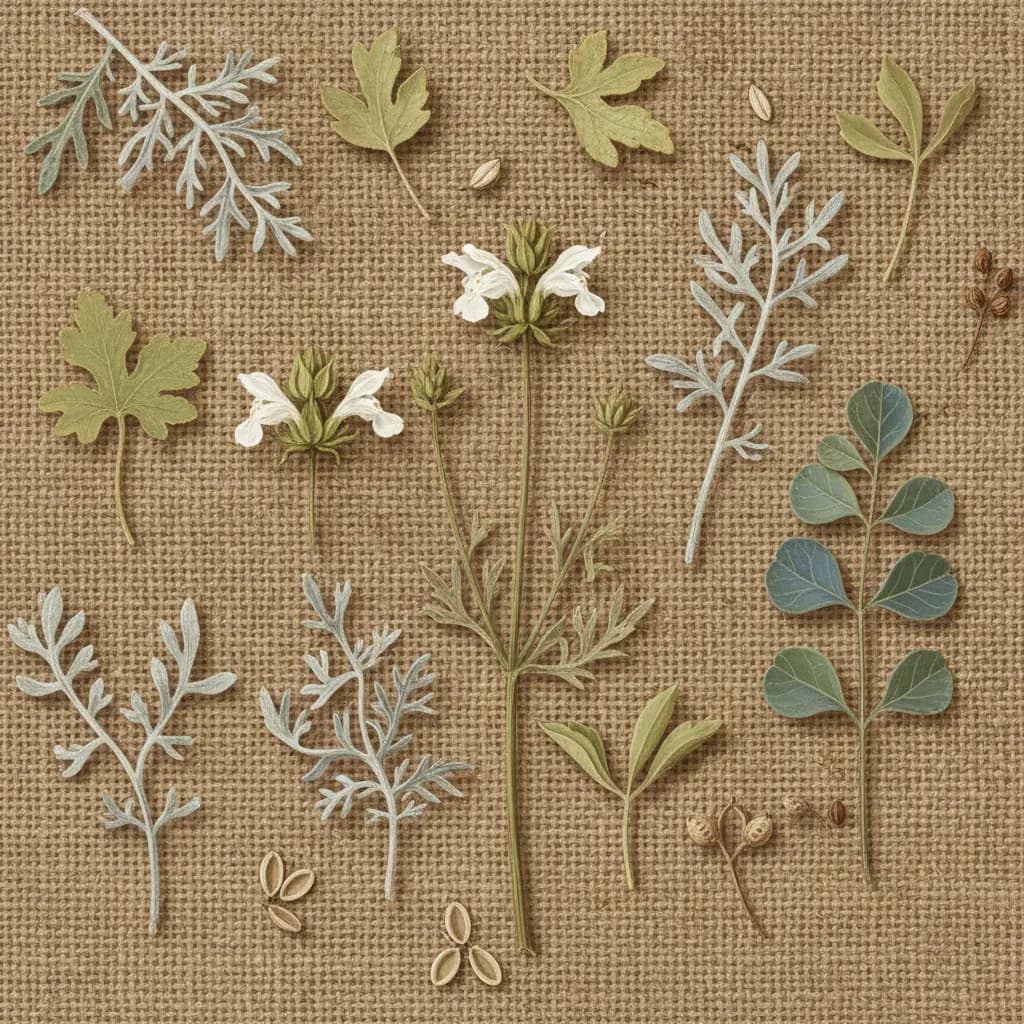
Intestinal parasites — pinworms, roundworms, threadworms — sit at the seam between the herbal and the classical registers, and the practitioner needs both. Six remedies carry most of this work: Cina maritima, Chelone glabra, Santoninum, Chenopodium anthelminticum, Ruta graveolens and Sabadilla. Each corresponds to a distinct pattern in the self-expressions of the organism under infestation — the nose-digging child who grinds teeth at night, the sallow adult with left-lobe hepatic soreness after a bad intermittent, the chilly subject with pinworm itch that alternates with itching in the nose. What follows is a practising differentiation, not a protocol.
Quick Answer
| Remedy | Best when |
|---|---|
| Cina maritima | Peevish child, digs the nose, grinds teeth in sleep, voraciously hungry yet emaciated, wants to be rocked |
| Chelone glabra | Sallow adult, left-lobe hepatic soreness extending downward, malaise after malarial illness, round or thread worms |
| Santoninum | Roundworm or threadworm with restless sleep, itching of the nose, night cough, yellow vision or deep-saffron urine |
| Chenopodium anthelminticum | Hookworm and roundworm; dull pain below the right scapula, deafness for human voice with sensitivity to high-pitched sound |
| Ruta graveolens | Worm colic in children that sits inside a wider Ruta picture of bruised soreness, restlessness, tendon weariness |
| Sabadilla | Pinworm, lumbrici or tapeworm; itching in the rectum alternating with itching in the nose or ears; chilly, oversensitive subject |
1. Cina maritima — The Wormseed Remedy
Best when: The child is peevish, digs the nose constantly, grinds the teeth in sleep, eats voraciously yet loses flesh, and screams to be rocked.
Cina is preeminently a worm remedy; Clarke elaborates the reflex signature. Its case is written on the face of the child. Dark rings under the eyes. One cheek red, the other pale. A bluish-white ring around the mouth. A sour smell rises from the body. The nose is rubbed and pressed constantly. Sleep is spent tossing, often on the belly or on hands and knees. Teeth grind. Bedwetting comes back with the full moon, the urine milky and turning turbid on standing. Nothing pleases: everything is offered and rejected, being looked at brings on a paroxysm, being touched or carried is refused, and yet the child screams to be rocked fast. Boericke sums up the whole gestalt in a single line: a hungry, irritable, ill-natured child who wants rocking.
A case that carries the whole pattern: a seven-year-old boy who bit his mother when she tried to comb his hair, refused to be lifted but screamed to be rocked hard and fast, ground his teeth all night, and wet the bed only in the days around the full moon. Cina 30C twice a day for two days settled the mental picture within a week, and roundworms passed in the stool by the fourth day. Classical prescribing sits at 30C and above; the mental signature is dynamic and rewards the higher scale. Worse: touch, being looked at, full moon, night, worms themselves. Better: lying on the abdomen, rocking, wiping the eyes.
2. Chelone glabra — The Liver Register
Best when: An adult carries sallow malaise after an intermittent fever, with soreness in the liver's left lobe that spreads downward, and round or thread worms.
Chelone is Burnett's remedy for the liver, and Boericke and Clarke preserve his indications intact. The pivot is a pain or soreness in the liver's left lobe that spreads downward — Burnett traced it as a line drawn from the hilus of the liver down to the fundus of the uterus. The picture is one of debility, not violence. Dyspepsia with hepatic torpor. Jaundice. The outer parts are tender on the surface, as though the skin had been stripped away, particularly about the elbow — a peculiar but well-confirmed keynote. And, for present purposes, round and thread worms in a subject whose vitality has been drained by malarial or otherwise exhausting illness. Chelone corresponds to the dumb-ague state, the ill-defined aching and low fever that trails severe intermittents, and it antidotes the quinine cachexia.
Prescribing here belongs to two registers. Boericke and Clarke both cite the tincture, given at one to five drops a dose; this is the herbal and organopathic register, and dosimetric caution applies. In classical practice Chelone 30C or 200C addresses the constitutional picture, and no molecule of the crude drug is present. Compare with China, Chenopodium, Cina, Helonias and Hydrastis where the anaemic, quinine-marked terrain is shared, and with Carduus marianus where left-lobe soreness alone dominates. Modality material is sparse, and the prescription rests on the affirmative keynote — hepatic soreness with worm infestation in a debilitated subject.
3. Santoninum — Colour Vision and Cystitis
Best when: Roundworm or threadworm with restless sleep, itching of the nose, twitching muscles, night cough, yellow vision or deep-saffron urine.
Santoninum is the neutral principle isolated from Cina, and Boericke records its therapeutic biography without disguise, calling it the old school's favorite anthelmintic, given chiefly against lumbrici. Its picture in the materia medica comes largely from cases of poisoning and from provings on the sensitive. The worm affections correspond closely to the "pain in shocks" of Cina, with gastro-intestinal irritation, itching of the nose, restless sleep, twitching. Santoninum reaches Ascaris lumbricoides and threadworms; it does not reach tapeworms. Around this therapeutic axis stand the extraordinary sensory disturbances. Yellow soup appears red; a blue evening sky appears green; white things look yellow. Colour blindness and xanthopsia. The urine is deep saffron, passes with strangury, stains linen; chronic cystitis and bedwetting have been cured by it. Hale recorded that Santoninum cured cases of "nervous blindness," and Boericke preserves the observation that a blind old man given the remedy for worms recovered partial sight, which led Hale to further trials in cataract.
For prescribing, the register matters more here than almost anywhere else in this list. The recorded poisoning cases — a boy of three given fifteen tablets each containing one-third grain of Santonin, seized with vomiting, dilated pupils, cyanosis and convulsions — are dosimetric events in the herbal register at material dose. Classical prescribing at 30C and above works with the dynamic image and cannot approach that threshold even in principle. Santoninum 30C where the sensory triad accompanies the worm picture; 200C where the mental picture dominates the case — what Boericke describes as deep depression, indecision and lack of self-confidence.
4. Chenopodium anthelminticum — Hookworm and the Auditory Signature
Best when: Hookworm or roundworm in a subject whose case includes right-sided complaints, dullness of hearing, or a dull pain below the angle of the right scapula.
Chenopodium anthelminticum — the American wormseed, botanically distinct from Cina — occupies an unusual position. Its herbal use is direct and dosimetric: oil of Chenopodium was for a long time the standard against hookworm and roundworm, and the poisoning literature that gives us its materia medica image is entirely a record of the herbal drug taken in material dose. Boericke and Clarke preserve the picture. The peculiar dull pain below the angle of the right scapula, lying closer to the spine than Chelidonium's comparable pain. Roaring in the ears, like cannons being fired. Progressive deafness for the human voice, with paradoxical sensitivity to passing vehicles and to high-pitched sound. Serous or bloody effusion in the labyrinth. Ménière's disease. Aphasia in the poisoning cases, with a curious compulsion to repeat every action — the patient who shook the doctor's hand twenty times in twenty minutes and then acted out washing his hands in a basin that held no water.
Prescribing splits cleanly. Oil of Chenopodium for hookworm is a herbal act, with real dosimetry, real toxicity and — as the poisoning records show — real hazard; fatal outcomes are recorded at one and a half ounces of the oil taken with turpentine. Classical prescribing at Chenopodium 30C uses the dynamic image, particularly where the auditory signature or the scapular pain accompanies the worm case. Compare with Chelidonium for right-sided liver pain, and with China, Opium and Lycopodium in the stertorous, puffing respiration of stroke-like states.
5. Ruta graveolens — Where Strain and Worms Meet
Best when: A child with worm colic whose case also carries the Ruta signature of bruised soreness, restlessness, and weariness in the flexor tendons or the eyes.
Ruta is not first-line in worms. It carries a single worm indication: colic in children from worms. That indication is for cases where the worm colic sits inside the wider Ruta picture, not for a general anthelmintic use. The wider picture belongs to injury and overuse. Bruised bones. Sprained flexor tendons. Ganglia at the wrist. Eye-strain from close work. The headache that feels as though a nail had been hammered in. Lameness after sprain. Where a child presents with worm colic on top of restlessness, aching, and the peculiar Ruta weariness — where the ordinary vermifuge remedies are not clearly indicated but the temperament fits — this is where Ruta earns its place.
Ruta's affinity is for fibrous tissue, flexor tendons, joints, cartilage, periosteum, uterus and skin, and the whole picture must be present for the prescription to hold. Ruta 30C where the colic is intermittent and part of a broader restless-bruised case; 200C for the deeper constitutional picture where the injury-and-strain temperament also runs through the child. Compare with Rhus tox for the sprained pain and Arnica for the bruised pain in muscle; Ruta reaches the bone and the tendon where those two do not.
6. Sabadilla — Pinworms and the Alternation with the Nose
Best when: Pinworm, lumbrici or tapeworm; itching and crawling in the rectum that alternates with itching in the nose or ears; a chilly, oversensitive subject.
Sabadilla enters homeopathic literature through Stapf's additions, with Hahnemann among the provers, and its worm indication is one of the oldest recorded uses of the plant — cebadilla seeds were used historically to destroy vermin. In the materia medica the worm picture and the hay-fever picture cross at a peculiar and unmistakable place: the itching. Itching and crawling in the rectum and anus, as though from ascarides, takes turns with itching in the nose or ears. Dry, tickling, itching in the nose that spreads over the whole body. Fluent coryza worse from the odour of flowers, or even the thought of them. Boericke and Clarke both give pinworms, lumbrici and tapeworm as clinical indications. The subject is chilly, sensitive to cold, oversensitive to odours, and often given to fixed erroneous impressions about their own body — imagining pregnancy where there is only flatus, imagining a limb is crooked.
For prescribing, Sabadilla's totality picture carries the case, and the worm indication is best treated as a keynote inside a wider constitutional match rather than as an isolated symptom. Sabadilla 30C for the pinworm case with clear alternation between anal and nasal itching; 200C where the mental signature — fixed erroneous ideas, timidity, over-response to mental effort — accompanies the physical picture. Better: heat, warm food and drink, being wrapped up, quick motion. Worse: cold air, mental exertion, odours, new and full moon.
How to Choose Between These Remedies
Two things need to be held together when choosing. Which parasite is confirmed or suspected, and which register — herbal or classical — the case belongs to.
Roundworm and threadworm sit inside the reach of Cina, Chelone, Santoninum and Chenopodium. Pinworm, lumbrici and tapeworm belong more specifically to Sabadilla. Hookworm is the historical province of Chenopodium in the herbal register. Ruta occupies its own place, indicated where worm colic sits inside its wider bruised-and-strained picture.
The register question is where most technical errors happen. Chenopodium, Chelone and Cina all have a working herbal tradition at Ø and low decimals; there the pharmacology of the crude drug is doing the work and the dose matters. Classical prescription at 30C and above meets the self-governing principle on the totality of the case, and dose-based safety data from the herbal literature do not apply to it. Confusing the two registers is the most common error made in this territory. Whenever pharmacological information is cited, the potency must be named — otherwise the finding is uninterpretable.
Terrain sits before the name of the parasite. The peevish, nose-digging child is a Cina case whether roundworm is confirmed or not. The sallow adult with left-lobe liver tenderness after a bad intermittent is a Chelone case even if worms are only suspected. Reach for the constitutional simillimum, not the anthelmintic — that instinct remains the safest guide.
Frequently Asked Questions
Which potency works best for worms in children?
For the classical picture — Cina, Sabadilla, Santoninum, Ruta — 30C given two or three times over a day and repeated only on the return of symptoms is where most practitioners begin. 200C is appropriate where the mental and constitutional signature is unambiguous. A higher potency is not stronger; it addresses a deeper stratum of the case.
Is there a role for the mother tincture? Yes, but in the herbal register only, and with knowledge of the pharmacology. Chelone Ø in one-to-five-drop doses (Boericke, Clarke) and oil of Chenopodium for hookworm belong to the drainage and organopathic tradition. These are not homeopathic prescriptions in Hahnemann's sense; they are herbal ones, and the dosimetric literature applies to them.
Does the remedy replace deworming when infestation is confirmed? The classical prescription meets the organism's reaction to the parasite and frees it. Where a case has been correctly matched, expulsion of worms in the stool is a commonly observed accompaniment — Boericke records it under Cina and Santoninum, and Chenopodium was used by the old school precisely for this. The remedy does not act as a chemical vermifuge and does not need to.
Why is the full-moon aggravation in Cina worth attention? Because it is one of the small idiosyncratic keynotes that lifts Cina above the other worm remedies when it is present. Bedwetting worse at the full moon in an otherwise Cina-shaped child is often enough on its own to confirm the prescription.
Related Reading
- Digestive complaints: an introduction — /conditions/digestive/
- The potency scale in practice — /learn/glossary/potency/
- Keynotes and their limits — /learn/glossary/keynote/
References
- Hahnemann S. Organon of the Medical Art. 6th edition.
- Boericke W. Pocket Manual of Homoeopathic Materia Medica.
- Clarke JH. A Dictionary of Practical Materia Medica.
- Stapf E. Additions to the Materia Medica Pura (Sabadilla).
- Hale EM. New Remedies: Their Pathogenetic Effects and Therapeutic Application.
- Burnett JC. Diseases of the Liver.