What Are the Best Homeopathic Remedies for Respiratory Issues?
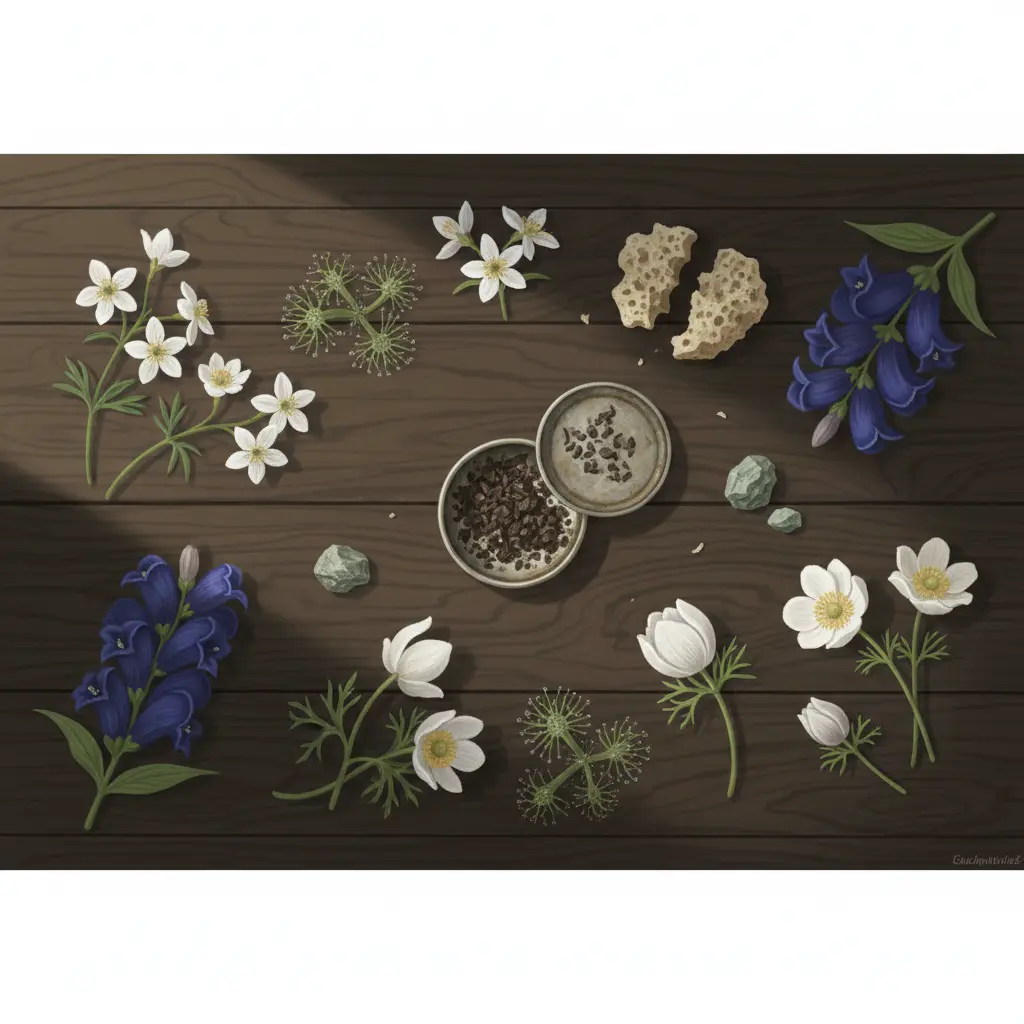
The best homeopathic remedies for respiratory issues include Aconitum (sudden onset from cold dry wind), Bryonia (dry painful cough, holds the chest), Antimonium Tartaricum (rattling chest, too weak to raise mucus), Drosera (spasmodic cough after midnight, ends in retching), Spongia Tosta (dry barking croup before midnight), Phosphorus (hoarseness, tight chest, craves cold drinks), and Pulsatilla (thick bland yellow-green catarrh, better open air). Each is chosen by the character of the cough, the time it worsens, and what relieves it — not by the diagnosis.
Quick Answer
| Remedy | Best when… |
|---|---|
| Aconitum | Sudden onset hours after cold dry wind; dry burning fever, restlessness, fear |
| Bryonia | Dry painful cough worse any motion; patient holds the chest; thirst for cold water |
| Antimonium Tartaricum | Loud rattling chest, weakness, can't raise the mucus; better sitting up |
| Drosera | Spasmodic barking cough in fits, worse after midnight; ends in retching or vomiting |
| Spongia Tosta | Dry croupy cough like a saw through pine; worse before midnight; better warm drinks |
| Phosphorus | Hoarseness, chest tightness, hard tight cough; craves cold drinks; worse left side |
| Pulsatilla | Thick bland yellow-green discharge; better open air; thirstless and weepy |
1. Aconitum — First Hours After Cold Dry Wind
Best when: a cough, croup, or fever erupts within hours of exposure to cold dry wind, with fear, restlessness, and hot dry skin.
Aconitum is the opening remedy of acute respiratory disease — Murphy calls it "a storm with a sudden onset and a sudden dissipation." The trigger is almost always dry cold wind. Within hours: dry, hoarse, croupy cough, hot dry skin, unquenchable thirst for cold water. In croup the child grasps the throat with every coughing fit and wakes near midnight in panic. The mental signature fixes the prescription: fear out of proportion to the illness. Aconitum acts only in the first 24 to 48 hours. 30C every two hours the first day; 200C at the onset of croup.
Worse: cold dry wind; evening and after midnight; warm room Better: open air; rest; warm sweat once it breaks
Quick reference: First hours after cold dry wind. Hot dry skin, fear, dry croupy cough, thirst for cold water.
2. Bryonia — Dry Painful Cough That Hates Motion
Best when: the cough is dry, hard, painful, and every cough makes the patient hold the chest because motion of the ribs hurts.
Bryonia takes over when the case slows. Mucous membranes are dry everywhere — lips parched, tongue coated white down the middle — yet expectoration is scanty. The cough is dry, hard, very painful, set off by coming into a warm room. Painful coughs must hold the chest: the patient presses the sternum to splint the painful side. Worse from any motion, even moving the eyes; better lying still on the painful side. Thirst is for large quantities of cold water at long intervals. Useful across bronchitis, pleurisy, pneumonia with rusty sputum, and flu settling in the chest. 30C two or three times daily; 200C for sharper pleuritic pain.
Worse: any motion; deep breathing; warm room; 3 to 4 a.m. Better: lying still on the painful side; firm pressure; cool drinks
Quick reference: Dry painful cough, holds the chest, hates motion, thirsty for big drinks of cold water.
3. Antimonium Tartaricum — Rattling Chest Without the Strength to Clear It
Best when: the chest is loud with rattling mucus but the patient is too weak to raise it, drowsy, pale, and covered in cold sweat.
Antimonium Tartaricum belongs to the late, exhausted phase of a chest illness — bronchitis turning to bronchopneumonia, flu that has loaded the chest with mucus the body cannot expel. Murphy's keynote: "great rattling of mucus, but very little is expectorated." The patient is drowsy with all complaints, face pale or bluish, alae nasi flapping, cold clammy sweat on the forehead. Children cling and whine, do not want to be touched or looked at, want to be carried upright. Warmth and lying down aggravate; belching and expectoration give some relief. 30C two to four times daily; 200C in the rattling stage. In severe cases the remedy works alongside conventional care.
Worse: warmth, lying flat; anger; sour things and milk; morning Better: sitting upright; expectoration; cold open air; lying on the right side
Quick reference: Loud rattling, no strength to raise. Drowsy, pale, cold clammy sweat. Held upright.
4. Drosera Rotundifolia — Spasmodic Fits After Midnight
Best when: the cough comes in rapid spasmodic fits that take the breath away, worse after midnight, often ending in retching or vomiting.
Drosera is Hahnemann's whooping-cough remedy, and the picture extends to every paroxysmal cough of the same character. Attacks follow each other very rapidly; the patient can scarcely breathe between them. The cough is deep, barking, choking, with a violent tickling in the larynx that sets off the next fit. As soon as the head touches the pillow the tickling starts. The classic time is after midnight, and the spell ends with gagging, retching, or vomiting, sometimes a nosebleed. The patient holds the chest during the cough; the voice is deep, hoarse, hollow — "as if a feather were lodged in the larynx." 30C every two hours during the spasmodic phase, tapered as fits subside.
Worse: after midnight; lying down; warmth of bed; talking, singing; sour food Better: sitting up in bed; pressure on the chest; quiet
Quick reference: Fits of barking cough after midnight, can't catch breath between, ends in vomiting.
5. Spongia Tosta — Dry Barking Croup Worse Before Midnight
Best when: the cough is dry, hard, barking, croupy, worse before midnight, better from warm drinks and from eating.
Spongia is the great remedy of dry croup; where Aconitum opens the case, Spongia carries it. Murphy's image: the cough sounds "as if a saw were being driven through a pine board," dry as a bone, hollow, foghorn-like, worse on inspiration. The larynx feels dry, constricted, plugged. The patient is awakened before midnight with a sense of suffocation, sits up gasping. Boenninghausen's classical croup sequence runs Aconite, then Spongia, then Hepar. What separates Spongia from Drosera: Spongia is worse before midnight, Drosera after; Spongia is better from warm drinks and eating. 30C every two hours during the croupy phase; 200C at the onset.
Worse: dry cold wind; before midnight; talking, singing; lying down; tobacco Better: eating; warm drinks; lying with head low
Quick reference: Dry croupy cough like a saw through pine. Worse before midnight. Better from warm drinks.
6. Phosphorus — Hoarseness, Tight Chest, Cough Goes Down
Best when: the patient is hoarse, tight across the chest, with a hard dry cough that runs from the throat into the lungs, craving cold drinks and worse lying on the left side.
Phosphorus reaches the case where the cold "goes down" — the sore throat that drops into the bronchi within a day, the laryngitis that turns the voice to a whisper, the bronchitis threatening pneumonia of the left lower lobe. The cough is hard, dry, tight, racking, set off by a tickle in the larynx that worsens with cold air, laughing, talking, or going from a warm room into the cold. The chest feels as if a great weight lay on the sternum; the whole body trembles with the cough. Sputum is rusty, blood-streaked, or salty-tasting. Two anchors: thirst for cold drinks (ice water, sometimes vomited back as it warms in the stomach), and worse lying on the left side. Phosphorus constitutions are tall, slender, fair, easily frightened by storms, prone to colds that "always go to the lungs." 30C two or three times daily; 200C for sharper acutes.
Worse: cold air; warm-to-cold transitions; talking, laughing; lying on the left side; thunderstorms; twilight Better: cold drinks; short naps; lying on the right side; rubbing; company
Quick reference: Hoarse, tight chest, hard dry cough that runs down. Craves cold drinks. Worse left side.
7. Pulsatilla — Thick Bland Yellow-Green Catarrh
Best when: the catarrh is thick, bland, yellow or yellow-green, the patient is thirstless and weepy, and everything is better in cool open air.
Pulsatilla arrives later in a respiratory illness — the cold that has settled into the sinuses, the bronchitis of a child who weeps for company, the lingering productive cough after measles. The keynote is the discharge: thick, bland, profuse, yellow to yellow-green, neither acrid nor burning, dropping down the throat and coming up with a loose morning cough. The dry cough of the evening becomes a loose cough of the morning. Three further notes: thirstlessness despite a dry mouth, better in cool open air and worse in warm stuffy rooms, and a mild, tearful, clinging mood — children want to be carried slowly. Useful for sinusitis with thick green discharge, productive post-cold cough, ear infection following a cold, and the catarrhal tail end of measles or flu. 30C two or three times daily. Often follows Bryonia or Phosphorus.
Worse: warm stuffy rooms; rich fatty food; evening and twilight; getting feet wet Better: cool open air; slow gentle motion; consolation; uncovering
Quick reference: Thick bland yellow-green discharge. Thirstless, weepy, wants open air.
How to Choose Between These Remedies
The choice follows the character of the cough, when it worsens, and what relieves it:
- First hours after cold dry wind, dry hot skin, fear → Aconitum
- Dry painful cough, holds the chest, hates any motion → Bryonia
- Loud rattling chest, weak, can't raise the mucus → Antimonium Tartaricum
- Spasmodic fits after midnight, ending in retching → Drosera
- Dry barking croup, worse before midnight, better warm drinks → Spongia Tosta
- Hoarse, tight chest, cough runs into the lungs, craves cold drinks → Phosphorus
- Thick bland yellow-green discharge, thirstless, better open air → Pulsatilla
The remedies sequence across a single illness. A winter bronchitis might begin with Aconitum the night the chill came on, move to Bryonia when the cough turns dry and painful, slide to Phosphorus if the case drops into the chest, then settle into Pulsatilla as the yellow-green tail end appears. Croup follows Boenninghausen's sequence: Aconitum, Spongia, Hepar Sulphuricum. Modality is more decisive than diagnosis.
Frequently Asked Questions
How quickly do homeopathic remedies for respiratory issues work?
A well-matched acute remedy often acts within hours. Aconitum at the onset of a chill can shorten the case to a single restless night. Spongia or Drosera quiets a spasmodic cough within one or two doses. Chronic catarrh clears over days as the discharge thins.
Can I combine multiple homeopathic remedies for respiratory issues?
Classical practice is one remedy at a time, repeated until the picture changes, then re-chosen. Respiratory cases often sequence — Aconitum into Bryonia, Bryonia into Phosphorus, Spongia into Hepar — but each transition follows the symptoms, not a fixed schedule. Alternating two remedies hourly makes the response harder to read.
What potency should I use for respiratory issues at home?
30C is the standard self-prescribing potency: three pellets under the tongue every one to four hours during the acute phase, tapered as symptoms ease. 200C suits stronger single-dose situations — a sudden croup at midnight, a sharp pleuritic stitch. Higher potencies belong to a practitioner. Stop dosing as soon as clear improvement begins.
When should I see a homeopathic practitioner for respiratory issues?
A practitioner is valuable when the cough is recurrent, chronic (asthma, chronic bronchitis, recurrent sinusitis), or when an acute case hasn't responded within a day or two of well-matched dosing. Constitutional prescription resolves the susceptibility — why each cold goes to the lungs — rather than the surface symptoms alone.
Are these remedies safe for children and pregnant women?
Yes. All seven are gentle preparations used freely across the lifespan. Pulsatilla and Aconitum are well-loved in childhood respiratory illness; Antimonium Tartaricum is a classical remedy for the rattling chest of infants and the elderly.
When to Seek Professional Care
Individualized prescription becomes valuable when respiratory illness becomes a pattern: the third winter bronchitis in a row, the asthma that began after a flu and never settled, the sinusitis that returns with every weather change. These signal that the self-governing principle of the organism has not reorganized its breathing, and a practitioner can find the deeper similar.
Conventional evaluation is needed for severe shortness of breath at rest, cyanosis, chest pain radiating to the arm or jaw, coughing up frank blood, high fever with confusion in an elderly patient, suspected pneumonia in an infant, and any croup or asthma attack that does not respond rapidly. These remedies work alongside emergency care, not in place of it.
Related Reading
- Homeopathy for Asthma
- Homeopathy for Bronchitis
- Homeopathy for the Common Cold
- Homeopathy for Cough
- Homeopathy for Croup
- Homeopathy for Hay Fever
- Homeopathy for Influenza
- Homeopathy for Sinusitis
- Homeopathy for Sore Throat
- Allium Cepa — Remedy Profile — the acrid-nasal, bland-tearing cold remedy
- Seasonal Allergies and Hay Fever — extended treatment of allergic rhinitis with Allium cepa, Sabadilla, and Wyethia
- Glossary: Modality · Keynote
References
- Boericke, W. Pocket Manual of Homoeopathic Materia Medica. 9th ed. B. Jain Publishers, 2002.
- Clarke, J.H. A Dictionary of Practical Materia Medica. B. Jain Publishers, 2005.
- Kent, J.T. Lectures on Homoeopathic Materia Medica. B. Jain Publishers, 2006.
- Murphy, R. Nature's Materia Medica. 3rd ed. Lotus Health Institute, 2006.
- Hering, C. The Guiding Symptoms of Our Materia Medica. B. Jain Publishers, 1997.
- Allen, H.C. Keynotes and Characteristics with Comparisons of some of the Leading Remedies of the Materia Medica. B. Jain Publishers, 2002.